The Florida contractor exam study guide for 2026.
The updated 2026 study guide for the Florida CGC exam — books, fees, hours, and a week-by-week study plan built for working adults.
Last updated: April 2026. We refresh this guide every time the DBPR reference list, fees, or exam structure changes.
If you’re studying for the Florida Certified General Contractor exam in 2026, most of the “study guides” you’ll find online were written two, five, or ten years ago. The reference books have changed. The fees have changed. The emphasis has shifted. Parts of the old advice are still right. Parts of it will get you failed.
This guide is the current one. It covers what’s on the 2026 DBPR reference list, what the exam actually costs this year, how to build a study plan around a full-time job, and what to prioritize if you only have a few weeks left. If you’ve read our pillar guide on how to pass the Florida GC exam, treat this as the practical companion — the one you actually study from. If you haven’t confirmed you’re eligible to sit yet, check the Florida GC license requirements first.
The short version
- Three parts: Business & Finance (120 questions, 6.5 hours), Contract Administration and Project Management (60 questions, 4.5 hours each). You need 70% to pass each.
- Exam fees are $295 if you pass everything first try — $135 PTI plus $80/$40/$40 Pearson VUE.
- The 2025 Florida Contractors Manual has been the required edition for Business and Finance since February 1, 2026, and for Contract Administration and Project Management since July 1, 2026, along with the 2025 BCSI (a Contract Administration and Project Management reference only).
- The 12-week plan is the baseline for working candidates; I’d plan on 100 to 150 total study hours.
- Take full-length timed practice exams and hit 80 to 90 percent before you schedule the real thing.
What changed in 2026
The biggest change to the Florida contractor exam in 2026 was the switch to new editions of two reference books, in two steps:
- February 1, 2026: Business and Finance switched to the 2025 edition of the Florida Contractors Manual.
- July 1, 2026: the Contract Administration and Project Management list switched to the 2025 Florida Contractors Manual (R50) and the 2025 BCSI (R247, Building Component Safety Information: Guide to Good Practice for Handling, Installing, Restraining & Bracing of Metal Plate Connected Wood Trusses).
What this means in practice: whichever part you’re taking, use the 2025 Florida Contractors Manual. If you’re taking Contract Administration or Project Management, use the 2025 BCSI too. BCSI is only on the Contract Administration and Project Management list.
Everything else — statutes, AIA documents, Builder’s Guide to Accounting, the trade books — is stable for 2026.
The 2026 exam at a glance
| Exam Part | Scored Qs | Pilot Qs | Time | Pass | Pearson VUE Fee |
|---|---|---|---|---|---|
| Business & Finance | 120 | 5 | 6.5 hours | 70% | $80 |
| Contract Administration | 60 | 5 | 4.5 hours | 70% | $40 |
| Project Management | 60 | 5 | 4.5 hours | 70% | $40 |
Plus: $135 PTI registration fee each time you register, regardless of how many parts you sit. All three parts must be passed within four years of your first attempt. Open book. Bring your own calculator — silent, hand-held, battery-operated, non-printing, no alphabetic keypad. No handwritten notes inside books. No moveable tabs — if you use Post-it Flags, they’ll ask you to remove them.
Total exam fees alone in 2026: $135 + $80 + $40 + $40 = $295, assuming you pass every part on the first try. Fail B&F and retake it? Another $135 + $80. That’s why prep that works is cheap insurance.
The 2026 reference book list
This is the section that gets outdated fastest, so here’s the rule: always cross-check against the official DBPR reference lists before you buy. We keep PDF copies in the course, and the DBPR publishes them on their website. The two lists you need are the Business & Finance CBT Reference List and the GC/BC/RC CBT Reference List (for Contract Administration and Project Management).
Business & Finance — what you need to bring:
- Florida Contractors Manual (2025 edition, required since February 1, 2026). DBPR lists it as including the 2025 Circular E, so you don’t need a separate tax guide.
- Builder’s Guide to Accounting, Revised Edition — Michael C. Thomsett
- AIA Document A201 — General Conditions of the Contract for Construction
- AIA Document A401 — Standard Form of Agreement Between Contractor and Subcontractor
- AIA Document A701 — Instructions to Bidders
- Florida Statutes — Chapter 455 (Business and Professional Regulation)
Contract Administration and Project Management — trade books:
- Florida Contractors Manual (same as above, editions matter)
- Building Component Safety Information (BCSI), 2025 edition, required since July 1, 2026
- Placing Reinforcing Bars — CRSI
- Principles and Practices of Commercial Construction
- Blueprint Reading for the Building Trades
- Scheduling reference (CPM)
- OSHA 29 CFR 1926 (construction standards)
- Several other trade references (full list varies by year — check the DBPR PDF)
Our Business and Finance set is $499. For the other two parts, prices depend on where you buy and whether you buy used. We have a full breakdown of exactly what to buy, where, and in what order. One tip: some of these books are only sold new by specific suppliers. Don’t wait until the week before your exam to order them.
How to build a study plan around a full-time job
Most of the people we talk to are working 40 to 60 hours a week in construction already, then trying to cram studying into nights and weekends. Here’s a study plan that actually survives contact with real life.
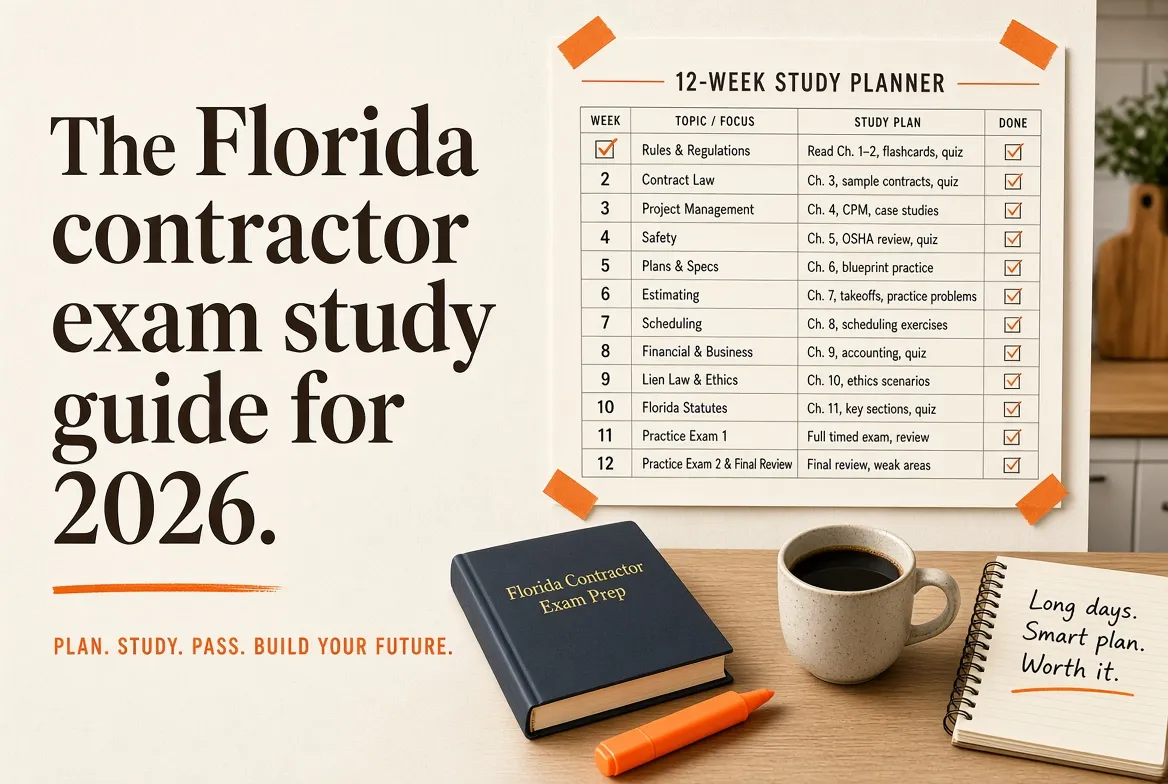
The 12-week baseline plan
Twelve weeks is the sweet spot for most working candidates. Shorter and you’re rushing B&F. Longer and motivation fades. Here’s the skeleton:
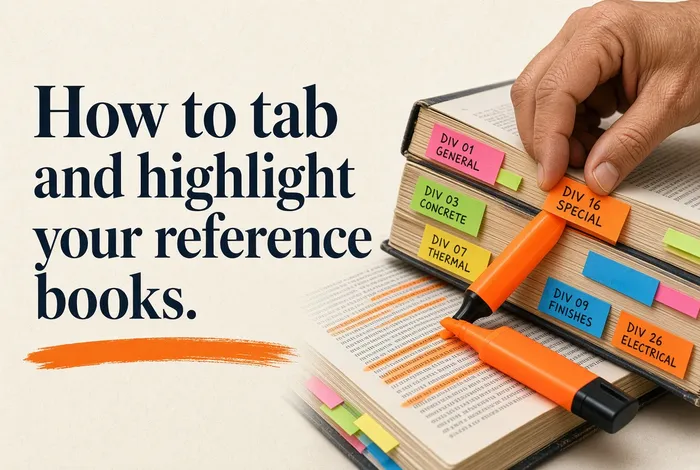
Weeks 1–2 — Set up. Order books. Tab them. Highlight key sections per the DBPR-allowed rules (original markings only, no loose notes). Read the exam instructions document so you know what to expect at the testing center. Schedule your first exam date — having it on the calendar makes everything real.
Weeks 3–6 — Business and Finance deep dive. This is the longest section and the hardest one to retake. Start here. Cover accounting basics, estimating, markup vs. margin, lien law (Chapter 713), workers’ compensation, OSHA, insurance, business structure, and the financial ratios. Take a full timed B&F practice exam at the end of week 6 — expect to fail it. That’s data, not a verdict.
Weeks 7–9 — Contract Administration and the AIA documents. AIA A201, A401, and A701 are the heart of Contract Administration. Know them cold. Practice finding specific clauses by number — questions will ask you to reference them directly. Study change orders, payment applications, and contract document hierarchy.
Weeks 10–11 — Project Management and scheduling. CPM scheduling is intimidating for candidates who haven’t used it day-to-day. Walk through the calculations on paper until they feel routine. Study submittals, RFIs, close-out procedures, and site management.
Week 12 — Full practice exams under real conditions. Take at least two full-length timed practice exams for each section you’re testing. Your goal is 80 to 90 percent. If you’re below 70 on practice exams one week out, push the test date. Failing costs you $215 minimum. Rescheduling costs nothing.
The 6-week crash plan (for retakers or late starters)
If you’re retaking a section or you’ve got six weeks until your test date and you’ve been putting it off, here’s the compressed version:
- Week 1: Tab and highlight books. Full diagnostic practice exam — use the results to rank topics by weakness.
- Weeks 2–4: Hit the three weakest topics hard. Do not try to study everything. Study what you’re losing points on.
- Week 5: Full timed practice exams. Simulate test-day conditions.
- Week 6: Light review. Rest the day before. Don’t cram.
Hours per week, honestly
- Comfortable pace: 8–10 hours per week for 12 weeks = 100–120 total hours.
- Tight pace: 12–15 hours per week for 8 weeks = 100–120 total hours.
- Crash pace: 20 hours per week for 6 weeks = 120 total hours.
Most successful candidates we talk to land between 100 and 150 total study hours. If you’re doing less than 80, you’re rolling dice. If you’re doing more than 200, you’re overcooking it and probably need better materials, not more time.
What to study first if you’re short on time
Here’s the prioritization most guides won’t give you. If you only have one week and you haven’t studied, this is the order:
- The exam instructions and the three-pass method. Knowing how to take the test is worth more than memorizing another chapter. See our pillar guide for the three-pass method.
- Lien law — Florida Statutes Chapter 713. Guaranteed to show up. Heavily weighted on B&F. Bookmark every section heading.
- Markup vs. margin. Candidates confuse these two and lose easy points. A 20% markup is not a 20% margin. Know the formulas cold.
- AIA A201 — General Conditions. The single most-referenced document on Contract Administration. Tab every article.
- Workers’ compensation and insurance minimums. Straightforward lookups once you know where to find them.
- Contract hierarchy. Which document controls when there’s a conflict? This comes up every exam.
If you have more time, expand outward from there. But if your test is in seven days and you’ve barely opened a book, those six topics will save the most points per hour invested.
Open-book strategy: what “open book” actually means in 2026
The Florida GC exam is open book. It has always been open book. But every year candidates walk in thinking open book means they don’t need to study, and every year those candidates fail. Here’s what open book actually means in 2026:
- You bring a pre-approved set of original reference books. No photocopies of books that aren’t on the bound-PDF list. No secondary editions.
- You can tab and highlight your books, but the tabs must be adhesive and permanent. No Post-it Flags. No loose notes. No handwritten annotations beyond highlighting.
- You can bring your own calculator. It has to be silent, hand-held, battery-operated, non-printing, and have no alphabetic keypad. Solar isn’t recommended — testing rooms are dim. No phones, no laptops.
- You cannot bring phones, watches, bags, or any outside materials into the testing area.
- For Spanish-language testers, you can bring a word-to-word translation dictionary — but no definitions allowed. The dictionary must translate, not explain.
The reason candidates fail open-book exams is timing, not knowledge. Business and Finance gives you 6.5 hours for 125 questions. That’s about 3 minutes per question. If you have to look up every question from scratch because your books aren’t tabbed and you don’t know the material, you’ll average 5 minutes per question and run out of time around question 75. That’s a sub-70% score even if you got everything you answered right.
The fix: know the material cold enough to answer half the questions without ever opening a book, and use the books as confirmation for the other half. That’s what separates passers from failers on this exam.
Practice exams: the single biggest predictor of passing
Everyone we’ve talked to who passed B&F on the first try did the same thing: they took full-length timed practice exams and scored 80 percent or higher before scheduling the real one. Everyone who failed either skipped practice exams entirely or did untimed ones on their phone while watching TV.
Here’s the standard we recommend:
- Minimum three full-length timed practice exams per section before sitting for the real thing.
- Use only your reference books — no internet, no notes, no Googling.
- Time yourself exactly: 6.5 hours for B&F, 4.5 hours for CA and PM.
- Score yourself honestly. If you got a question right by accident, mark it wrong. Practice is for learning, not ego.
- Review every wrong answer. Write a one-sentence note on why it was wrong — did you not know the material, or did you know it and misread the question? The second is a test-taking problem, which is fixable fast.
Our free general contractor practice test is timed — use it to see how the clock actually feels. If you’re studying with any other resource, just make sure you’re getting full-length timed practice somewhere. Random 10-question quizzes do not prepare you for a 6.5-hour exam.
What we’re seeing in 2026
A few patterns worth knowing from the 2026 cycles so far:
- Questions on the 2024 lien law updates (Chapter 713 amendments) are showing up consistently. If your study materials are from 2023 or earlier, they might not reflect this.
- More candidates are reporting scheduling calculations on Project Management — CPM forward-pass and backward-pass questions. Practice these with pencil and paper.
- B&F accounting questions have leaned more on cash vs. accrual recognition than in previous cycles. Know the difference and know when each applies.
- Spanish-language testers are reporting that the translation dictionary rule is being enforced strictly — bring a clean word-to-word dictionary, not one with definitions.
None of these are dealbreakers. But they’re the kind of things a 2019 study guide won’t tell you.
Your next step
If you’re building your own study plan from scratch, start with the 12-week baseline plan above and grab the free study kit: the exam cheat sheet and a licensing roadmap you can print and keep next to your books.
If you want the guided version, our Business and Finance course is $197 — the math worked step by step, timed practice, and your reference books set up so you can find an answer fast. It covers Business and Finance, the longest part, not all three exams. It’s being built now; the waitlist gets you the founding price.
The exam is passable. You just need a current study guide, a realistic plan, and enough timed practice to know you’re ready. This guide covers the first one. The other two are up to you.
This guide was last updated April 2026. We’ll refresh it when DBPR publishes the next reference lists, and again any time the DBPR changes the reference list, fees, or exam structure. If you notice something that looks out of date, email us — we’d rather fix it than leave candidates working from bad information.
Related posts
Ethan Notestine
•Aug 28, 2026