Florida contractor license types: CGC vs. CBC vs. CRC
The three Florida contractor licenses for building work, side by side: what a CGC, CBC and CRC license lets you build, the experience each one counts, the exams, and how to move up.
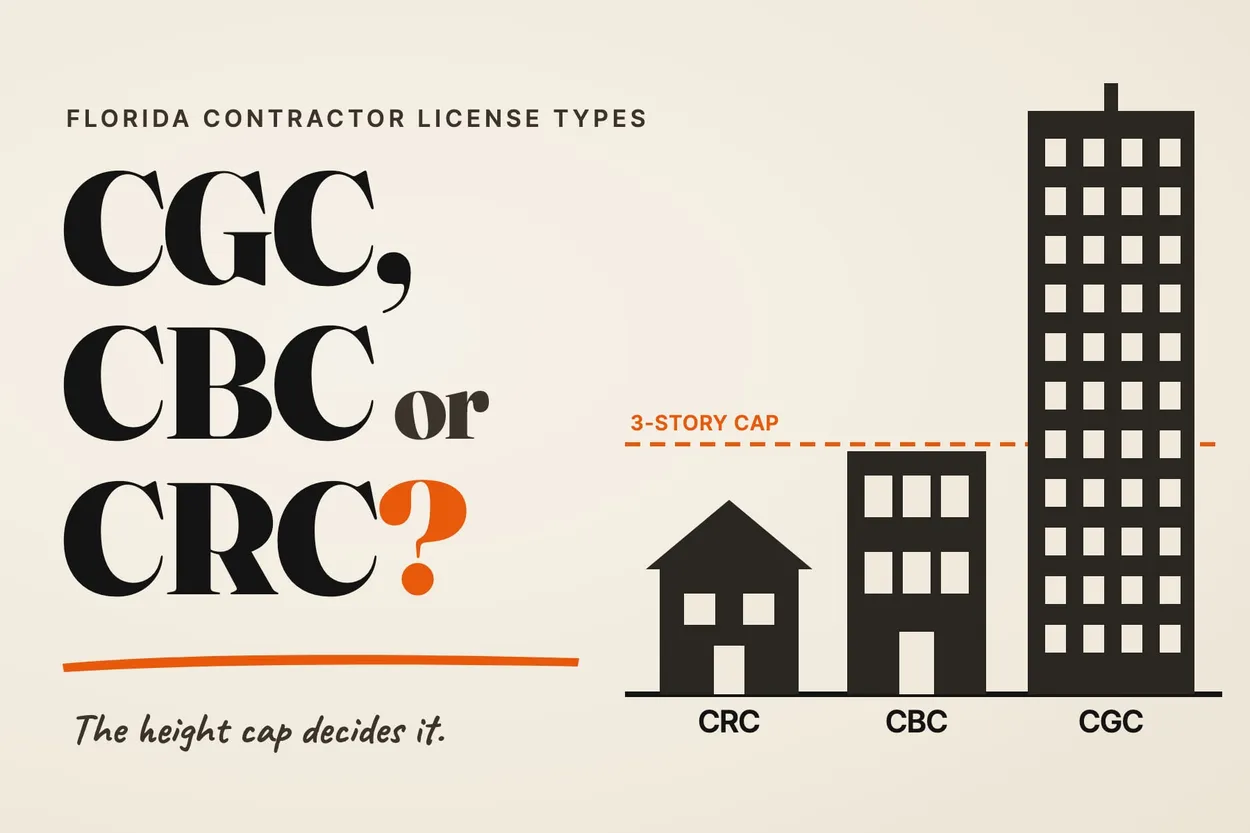
Florida has three state licenses for general building work: certified general (CGC), certified building (CBC) and certified residential (CRC). Here’s the thing most people miss. The licenses are capped by building height, and the experience rules follow the caps. So the license you can get depends on what you’ve already built, not on what you want to build next.
I’ll walk through what each license lets you build, the experience each one counts, the exams, and how to move up later. If you’d rather skip to your own answer, the planner does it in a couple of minutes.
The short answer
| Certified General (CGC) | Certified Building (CBC) | Certified Residential (CRC) | |
|---|---|---|---|
| What you can build | Anything, with no limit on type or height | Commercial and residential buildings up to 3 stories, plus non-structural remodeling of any size building | 1-, 2- and 3-family homes up to 2 habitable stories |
| Experience that counts | Commercial, in 4 of 6 structural areas | Commercial, in 4 of 6 structural areas | Residential, in 3 of 5 structural areas |
| Extra requirement | 1 year on buildings of 4+ stories | None | None |
| Business and Finance | 120 questions, 6.5 hours | Same exam | Same exam |
| Contract Administration | 60 questions, 4.5 hours | 50 questions, 4.5 hours | 45 questions, 4.5 hours |
| Project Management | 60 questions, 4.5 hours | 50 questions, 4.5 hours | 45 questions, 4.5 hours |
| Liability / property damage insurance | $300,000 / $50,000 | $300,000 / $50,000 | $100,000 / $25,000 |
All three are certified licenses. The state issues them, and they’re good anywhere in Florida. A registered license is local and only works where you hold a certificate of competency. Florida also licenses the trades (roofing, air conditioning, plumbing, pool, solar and others) as Division II. Those are separate licenses with their own exams. This post is about the three Division I licenses. For the whole licensing process, start with how to become a general contractor in Florida.
What each license lets you build
CGC: the certified general contractor license
Florida law describes a general contractor’s work as “unlimited as to the type of work.” If you want to build a hotel, a mid-rise office or anything over three stories, this is the only one of the three that lets you.
CBC: the building contractor license in Florida
A certified building contractor can build commercial and residential buildings of up to three stories. A CBC can also remodel or repair a building of any size, as long as the work doesn’t affect its structural members. So a CBC can’t put up a ten-story tower, but can renovate the inside of one.
CRC: the residential contractor license in Florida
A certified residential contractor builds one-, two- and three-family homes of up to two habitable stories, above no more than one uninhabitable story. Think single-family homes, duplexes and triplexes. If houses are all you build, this may be all you need.
The experience that counts (this is what decides it)
The years are the same for all three
The amount of experience doesn’t change between licenses. A year means 2,000 hours, and Florida gives you several ways to get there:
- Four years as a skilled worker or foreman, with at least one of them as a foreman.
- A four-year degree plus one year. For these three licenses, the CILB accepts only civil engineering, building construction or architecture degrees.
- College credit plus field time: three years of credit and one foreman year, two and two, or one and three. Credit never replaces the foreman year.
- Military service. Honorably discharged veterans can count up to three years of active duty, plus at least one foreman year.
Two rules apply on every route. The contractor you worked under has to have been properly licensed for that work at the time. And work that’s exempt from licensing, such as owner-builder work, doesn’t count.
What changes is the kind of work
CGC and CBC need commercial experience in at least four of these six areas:
- Foundations or slabs over 20,000 square feet
- Masonry walls
- Steel erection
- Elevated slabs
- Column erection
- Formwork for structural reinforced concrete
Storage, utility and accessory structures don’t count as commercial here. That covers barns, carports, garages, sheds, silos, tanks, towers, agricultural buildings and aircraft hangars.
CGC adds one more year: at least one year on structures four or more stories tall. A story has to have at least seven feet of clear height. This is the requirement that stops most people short of the general license, and it’s there because the CGC is the only license that can build above three stories.
CRC needs residential experience on detached one- and two-family homes and townhouses up to three stories above grade, in at least three of these five areas:
- Foundations, slabs or structural formwork
- Masonry walls
- Structural demolition
- Structural wood framing, including trusses (platform framing doesn’t count)
- Column erection
The trap: “smaller” doesn’t mean easier to get
People assume the residential license is the easy one to start with. It isn’t always. The CRC experience test only counts work on homes. If your four years were on commercial jobs, the residential test may not fit you at all. Meanwhile your commercial work might line up with the building license.
The same goes for framing. Platform framing doesn’t count toward the CRC list, so a framer’s years can come up short on structural areas even after a decade on houses.
The planner checks your experience against the license you want. If it doesn’t fit, the planner checks the other licenses too. So it can come back with something like “you want Residential, but on paper you look like Building.” The CILB makes the final call when you apply, but it’s far better to learn this before you pay for exams.
The exams: one shared, two that differ
All three licenses take the same three exams, and you need 70% on each:
- Business and Finance is identical for all three: 120 questions in 6.5 hours. It’s the longest of the three exams. It also has the lowest repeat-attempt pass rate of the three in every year of Pearson VUE’s data, 2020 through 2026. So whichever license you pick, the Florida Business and Finance exam is the same test.
- Contract Administration and Project Management get shorter as the license narrows: 60 questions each for general, 50 for building and 45 for residential, all with 4.5 hours.
One exemption changes the whole plan. With a bachelor’s degree in building construction and a GPA of 3.0 or higher, Florida law says you only have to pass Business and Finance. The two trade exams drop off.
Whichever license you choose, you have to pass all three exams within four years of your first attempt.
Moving up later
Starting with a CRC or CBC doesn’t lock you in. Once you hold an active certified license, Florida law lets you move up with experience in that license:
| From | To | Experience in your current license |
|---|---|---|
| CRC | CBC | 3 years |
| CRC | CGC | 4 years |
| CBC | CGC | 4 years |
Upgrades are easier than starting from scratch in two ways:
- The structural-area tests don’t apply. You don’t have to show four of six areas, and an upgrade to general doesn’t need the four-story year.
- You can skip Business and Finance. The Board’s rule lets an upgrade applicant skip it if there’s no pending investigation and no discipline beyond a notice of noncompliance, a letter of guidance or a citation. You’d still take the trade exams for the new license.
Which one should you go for?
Go for the highest license your experience supports today. Here’s how that usually sorts out:
- You’ve run commercial work in four of the six areas, including a year on four-plus-story buildings. On paper you look like a CGC.
- You’ve run commercial work in four of the six areas, but nothing four stories or taller. On paper you look like a CBC. Upgrade to general after four years.
- Your experience is on houses, in three of the five residential areas. On paper you look like a CRC. Upgrade to building in three years or general in four.
- You’ve got a building construction degree. Check your GPA first. At 3.0 or higher, you may only need Business and Finance.
The CILB makes the final call when you apply. The planner tells you what your experience looks like against the rules before you spend a dollar on exam fees. When you know which license you’re going for, the step-by-step guide covers the application, the books and the order to do it all in.
Rules checked against Florida Statutes 489.105, 489.111, 489.113 and 489.1131, and Rules 61G4-15 and 61G4-16, on September 30, 2026.
Frequently asked questions
What are the types of contractor licenses in Florida?
Florida's Construction Industry Licensing Board issues two groups of contractor licenses. Division I covers general building work: the certified general (CGC), certified building (CBC) and certified residential (CRC) licenses. Division II covers the trades, including roofing, sheet metal, air conditioning, mechanical, pool and spa, plumbing, underground utility, solar and specialty contractors. Electrical contractors are licensed separately, by the Electrical Contractors' Licensing Board.
What is a CBC license in Florida?
CBC stands for certified building contractor. It lets you build commercial and residential buildings of up to three stories, and remodel or repair a building of any size as long as the work doesn't affect its structural members. The experience has to be commercial, in at least four of six structural areas, the same test as the general contractor license, but without the year on buildings of four or more stories.
What is a CRC license in Florida?
CRC stands for certified residential contractor. It covers one-, two- and three-family homes of up to two habitable stories above no more than one uninhabitable story. It's the one Division I license whose experience can be entirely residential: work on detached one- and two-family homes and townhouses in at least three of five structural areas.
Do CGC, CBC and CRC candidates take the same exam?
They take the same Business and Finance exam: 120 questions in 6.5 hours. The two trade exams differ in length. Contract Administration and Project Management are 60 questions each for general, 50 for building and 45 for residential, all with 4.5 hours.
Can I upgrade from a CRC to a CGC license in Florida?
Yes. Florida law lets an active certified residential contractor move up to building with three years of experience in that license, or to general with four. An active certified building contractor can move up to general with four years. The six-area experience test and the four-story year don't apply to upgrades, and the Board's rule lets upgrade applicants skip Business and Finance if they have no pending investigation and no discipline beyond a notice of noncompliance, letter of guidance or citation.
Related posts