Florida general contractor license requirements, step by step.
Florida general contractor license requirements for 2026: experience, the three exams, CGC vs CBC vs CRC, insurance, credit, fees and how to apply.
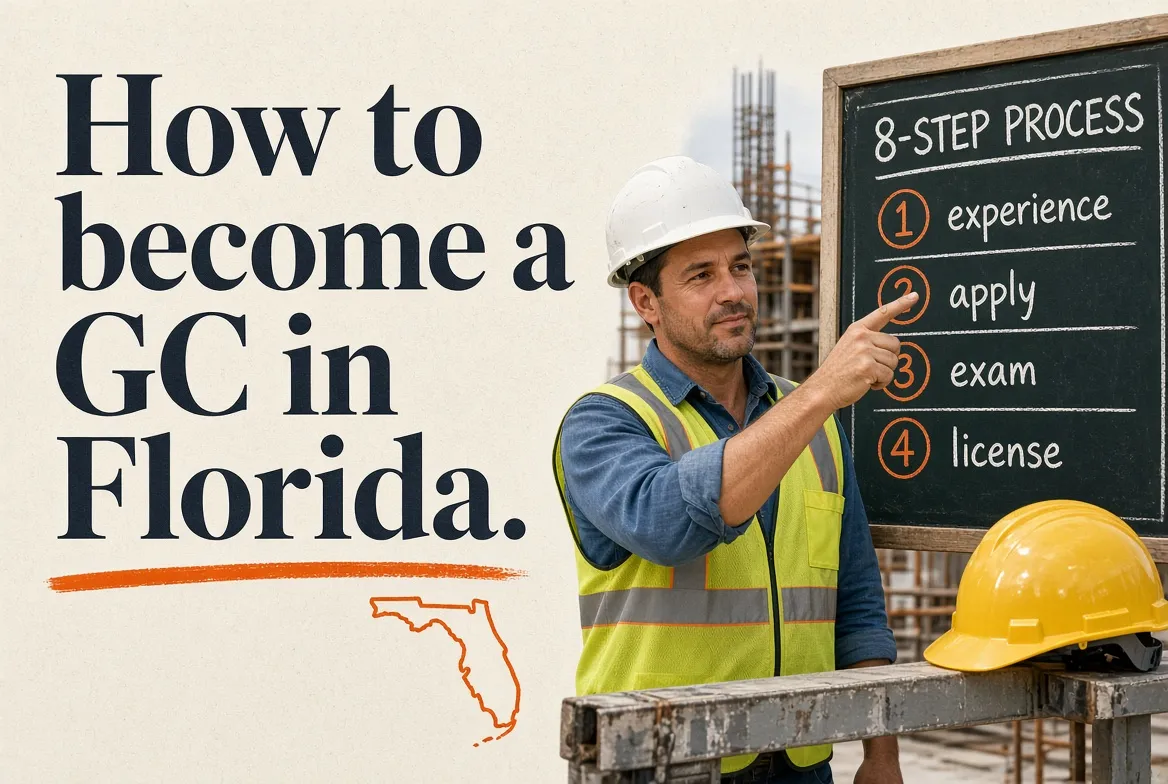
To get a Florida general contractor license, you need to be at least 18, have four years of qualifying construction experience (at least one of them as a foreman) or an approved mix of college and experience, pass three state exams, and show DBPR your credit, insurance and a clean background check. That license is the certified general contractor (CGC) license, the one with no limit on what you can build. This guide walks through every requirement in order, compares the general, building and residential licenses, and points out where people get stuck.
Florida contractor license requirements at a glance
| Requirement | What Florida asks for |
|---|---|
| Age | 18 or older |
| Character | Good moral character, confirmed by a fingerprint background check |
| Experience | 4 years, with at least 1 as a foreman, or a degree or college-credit route (below) |
| General contractor extras | Commercial experience in at least 4 of 6 structural areas, plus 1 year on buildings of 4 or more stories |
| Exams | Business and Finance, Contract Administration and Project Management, 70% on each |
| Credit | A personal credit report with a FICO score (DBPR’s benchmark is 660) |
| Insurance | $300,000 general liability and $50,000 property damage for general and building contractors |
| Workers’ comp | A policy or an exemption within 30 days of getting your license |
| Deadline | Pass all three exams within 4 years of your first attempt, then apply within 4 years of your most recent pass |
These come from Florida Statutes section 489.111, the Construction Industry Licensing Board’s rules, and DBPR’s published FAQ and application checklists. The sections below explain each one.
Certified vs. registered: which Florida contractor license you need
Florida has two kinds of contractor license. A certified license is issued by the state through the Construction Industry Licensing Board (CILB) and lets you work anywhere in Florida. A registered license only lets you work in the cities or counties where you hold a local certificate of competency.
When people say “Florida general contractor license”, they almost always mean the certified one, and that’s what this guide covers.
Florida contractor license types: CGC vs. CBC vs. CRC
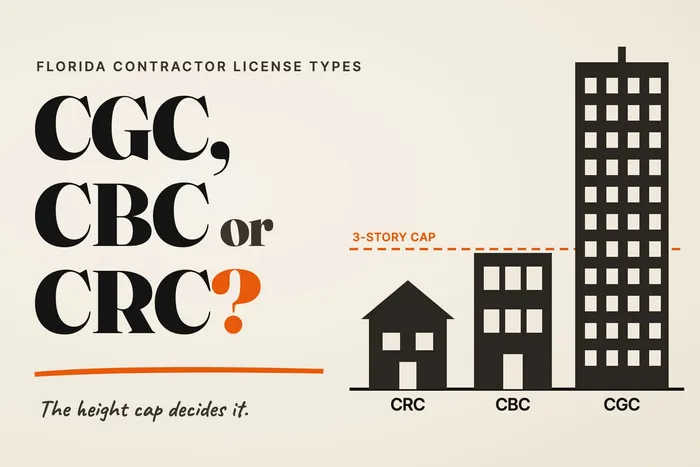
Three certified licenses cover general building work. They share the same basic eligibility rules and the same Business and Finance exam. They differ in what you’re allowed to build, the experience that counts, and the two trade exams you take. The detail on each one, and on moving up later, is in Florida contractor license types: CGC vs. CBC vs. CRC.
| Certified General (CGC) | Certified Building (CBC) | Certified Residential (CRC) | |
|---|---|---|---|
| What you can build | Anything. No limit on type or height | Commercial and residential buildings up to 3 stories, plus remodeling of any size building that doesn’t affect structural members | 1-, 2- and 3-family homes up to 2 habitable stories above no more than 1 uninhabitable story |
| Experience that counts | Commercial, in 4 of 6 structural areas | Commercial, in 4 of 6 structural areas | Residential, in 3 of 5 structural areas |
| Extra requirement | 1 year on buildings of 4+ stories | None | None |
| Business and Finance exam | 120 questions, 6.5 hours | Same exam | Same exam |
| Contract Administration | 60 questions, 4.5 hours | 50 questions, 4.5 hours | 45 questions, 4.5 hours |
| Project Management | 60 questions, 4.5 hours | 50 questions, 4.5 hours | 45 questions, 4.5 hours |
| Liability / property damage insurance | $300,000 / $50,000 | $300,000 / $50,000 | $100,000 / $25,000 |
Certified General Contractor (CGC)
The general contractor license has no scope limit. Florida law describes a general contractor’s services as “unlimited as to the type of work.” It’s the only one of the three that lets you build high-rises. That’s why it’s the only one that asks for a year of experience on buildings at least four stories tall.
Certified Building Contractor (CBC)
The practical difference between a certified building contractor and a general contractor in Florida is height and structure. A building contractor can build commercial and residential buildings up to three stories. They can also remodel or repair a building of any size, as long as the work doesn’t touch its structural members. The experience rules are the same commercial rules as for general contractors, minus the four-story year.
Certified Residential Contractor (CRC): the residential contractor license in Florida
If you build houses, the certified residential contractor license may be all you need. It covers one-, two- and three-family homes of up to two habitable stories (above no more than one uninhabitable story), plus accessory structures.
The big difference is experience. For a residential contractor license in Florida, your experience can be entirely residential. The CILB counts work on detached one- and two-family homes and townhouses up to three stories, in at least three of these five areas:
- Foundations, slabs or structural formwork
- Masonry walls
- Structural demolition
- Structural wood framing, including trusses (platform framing doesn’t count)
- Column erection
The trade exams are also shorter: 45 questions each for Contract Administration and Project Management, against 60 for the general contractor license. Business and Finance is the same exam for all three.
Which license should you go for?
Go for the highest license your experience supports. Florida law lets you move up later:
- An active certified residential contractor can get the building license after passing the building exam, with 3 years of experience as a residential contractor.
- An active certified residential or building contractor can get the general license after passing the general contractor exam, with 4 years of experience in their current license.
DBPR’s own FAQ suggests candidates consider taking the highest-level exam they can. A passing score on the general contractor trade exams can support a building or residential license, and a later upgrade, without retesting.
Experience requirements
Florida Statutes 489.111(2)(c) gives you three main ways to qualify. For every route, a full-time year means at least 2,000 hours.
Route 1: a four-year degree plus one year
A bachelor’s degree from an accredited four-year college, plus one year of experience in the license category. For general, building and residential licenses, the CILB only accepts three degrees: civil engineering, building construction or architecture.
Route 2: four years of experience
Four years of active experience as a skilled worker (able to command a mechanic’s rate in the trade) or as a foreman, with at least one of those years as a foreman in charge of a crew.
Route 3: college credit plus experience
College credits can replace some of the field time. They don’t have to be in construction, and junior and community college courses count. The foreman year can’t be replaced. The statute allows three combinations:
| Foreman experience | Skilled-worker experience | College credit |
|---|---|---|
| 1 year | none | 3 years |
| 1 year | 1 year | 2 years |
| 1 year | 2 years | 1 year |
Military experience
DBPR says experience gained in the military can count toward the requirement. You document it with your DD-214 and DBPR’s Military Service Verification form when you apply for your license. Veterans, their spouses and Florida National Guard members may also qualify for fee waivers or discounts.
What counts as experience
The CILB accepts experience gained under the supervision of a contractor who was properly licensed for that work at the time. Experience from other states can count if the work meets Florida’s definition for the license category. Work that’s exempt from licensing in Florida doesn’t count.
The extra rules for general, building and residential
For general and building contractor licenses, your experience has to be commercial construction in at least four of these six areas:
- Foundations or slabs over 20,000 square feet
- Masonry walls
- Steel erection
- Elevated slabs
- Column erection
- Formwork for structural reinforced concrete
General contractor applicants also need at least one year on structures of four or more stories.
Residential applicants need residential experience in at least three of five areas instead. The list is in the CRC section above.
How to get a general contractor license in Florida, step by step
Step 1: Pick your license and check your experience against it
Decide between general, building and residential using the table above. Then match your work history to one of the three experience routes and, for general and building, to the six structural areas. DBPR’s Candidate Information Booklet and the CILB’s FAQ answer most edge cases.
Step 2: File the exam application (the form people search for)
The Florida general contractor application form for the exam is DBPR’s CILB 1, Initial and Retake Examination Application. For certified licenses, you can apply directly with the exam vendor, Professional Testing, Inc. (PTI), or use DBPR’s printable version. Both are linked from DBPR’s Construction Industry Licensing Board page.
Read DBPR’s warning before you file: passing the exam doesn’t qualify you for a license on its own. Your experience, credit and background are checked when you apply for the license in Step 7. Make sure you meet every requirement before you pay for the exam.
Step 3: Get the reference books and tab them
Every part of the exam is open book, but only with the books on DBPR’s current reference lists, in the exact editions listed. You can highlight and use permanently attached tabs. Removable tabs, sticky notes and handwritten notes aren’t allowed.
Each exam has its own list. Here’s which books you need for each part. For Business and Finance, I sell the correct-edition Business and Finance book set for $499. Tab your books before you start timed practice so you’re practicing the lookups you’ll do on test day. The tab and highlight guide shows where.
Step 4: Study, starting with Business and Finance
The Florida Business and Finance exam is the longest of the three: 120 questions in six and a half hours, heavy on accounting math, and the clock is what usually beats people. If you can, start there.
If you want structured help with it, our Business and Finance course is $197. It has about 15 lessons with video, text, and practice questions.
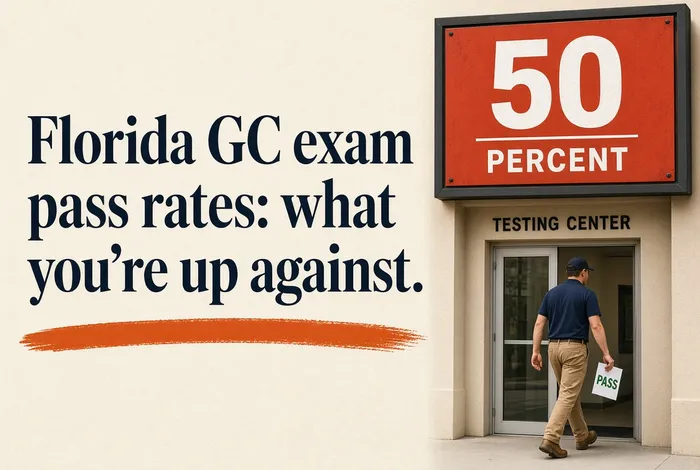
Before you book a date, read how hard the Florida GC exam is and look at the Florida general contractor exam pass rate for each section. Then take a free Florida general contractor practice test under the clock to see where you stand. Our guide on how to pass the Florida GC exam covers the three-pass method for managing time.
Step 5: Pass the three exams
You take the exams by computer at Pearson VUE test centers, and they’re offered year-round. You can take them on different days, and you see your result on screen when you finish. You need 70% on each part. The exam section below has the details.
Step 6: Line up your credit report and insurance
When you apply for your license, you’ll need:
- A personal credit report from a board-approved agency, including a FICO score and a search of local, state and federal records. DBPR’s FAQ uses 660 as the benchmark. Below that, it describes other ways to show financial responsibility, such as a board-approved financial responsibility course or a bond.
- Proof of insurance, by attestation: $300,000 general liability and $50,000 property damage for general and building contractors, or $100,000 and $25,000 for residential contractors.
Step 7: Apply for your license and get fingerprinted
After you pass, apply for the license on CILB 5-A (certified contractor as an individual) or CILB 6-A (if you’re qualifying a business). DBPR tells applicants to submit fingerprints through an FDLE-registered Livescan provider right after submitting the license application, not before. First-time DBPR Online Services users need to link their exam candidate ID to their account.
The license application fee is currently $245. The Livescan vendor charges you directly for fingerprints, and the price varies by vendor. DBPR’s own in-person service at its Tallahassee headquarters is $36.
Step 8: Workers’ comp, then keep it active
Within 30 days of your license being issued, you need workers’ compensation coverage or an exemption. Certified licenses renew every two years, by August 31 of even-numbered years, with 14 hours of continuing education.
The Florida contractor exam: what you’re taking
Division I contractors (general, building and residential) take three exams:
| Exam | General (CGC) | Building (CBC) | Residential (CRC) | Time |
|---|---|---|---|---|
| Business and Finance | 120 questions | 120 questions (same exam) | 120 questions (same exam) | 6.5 hours |
| Contract Administration | 60 questions | 50 questions | 45 questions | 4.5 hours |
| Project Management | 60 questions | 50 questions | 45 questions | 4.5 hours |
Question counts are scored questions. Each exam also includes a few unidentified pilot questions that don’t count, with extra time added for them. The passing score is 70% on each exam.
What’s on the general contractor trade exams
DBPR publishes the content weights in Rule 61G4-16.001. Each can move by up to 3%.
- Contract Administration (CGC): project contracts 40%, preconstruction 27%, licenses and permits 20%, construction procedures 13%.
- Project Management (CGC): construction methods, materials, tools and equipment 63%; safety 20%; plans and specifications 17%.
- Business and Finance (all three licenses): accounting 32%, administration 26%, government regulations 15%, establishing the business 11%, trade operations 10%, human resources 6%.
Retakes and the four-year window
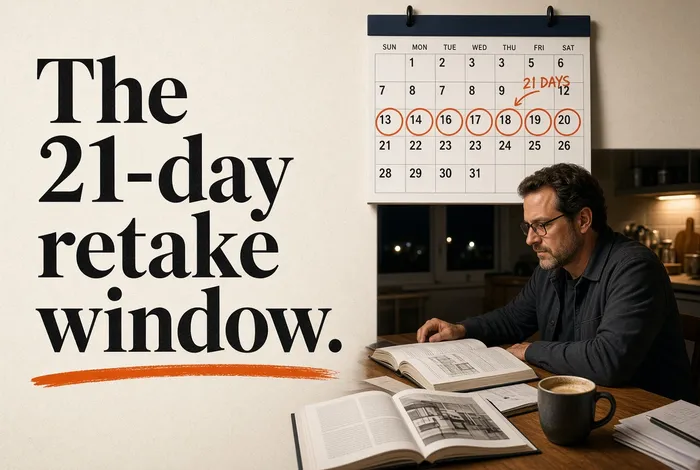
If you fail a part, you only retake that part, and you wait at least 21 days after that exam before you can sit it again. You reapply through PTI at floridaexam.com, paying the $135 registration again plus the fee for that part. There’s no limit on attempts, but you have to pass all three parts within four years of your first attempt, or your earlier scores no longer count. Once you’ve passed, your passing grades stay valid for four years from the part you passed most recently, so apply for your license inside that window.
If you want to go over a failed exam, you can request a review, which has its own review fee. It’s listed on DBPR’s examination administration and review fee schedule.
What a Florida general contractor license costs
The state’s fees are fixed. The rest depends on your choices and your vendors.
| Cost | Amount |
|---|---|
| Exam registration with Professional Testing, Inc. (PTI) | $135 each time you apply |
| Pearson VUE exam fee, paid when you schedule | $80 for Business and Finance, $40 for Contract Administration, $40 for Project Management |
| DBPR license application (certified contractor, as an individual) | $245 at the time of writing |
| Fingerprints | Set by the Livescan vendor. DBPR’s own in-person service in Tallahassee is $36. |
| Credit report with FICO score | Varies by agency |
| Insurance | Varies by insurer |
| Business and Finance reference books | $499 for our set |
If you pass every part the first time, the state exam and license fees come to $540: $295 in exam fees plus the $245 application fee. A retake costs the $135 registration again plus the fee for that part. For every line item, see our full breakdown of the Florida general contractor license cost. Wondering whether it pays off? We ran the numbers in is a GC license worth it?
Coming from another state: endorsement and reciprocity
Endorsement. If you’re licensed in another state, DBPR also offers certification by endorsement on form CILB 10. Under Florida Statutes 489.115(3), you can qualify if you passed a licensing exam substantially equivalent to Florida’s, if your state’s licensing criteria were substantially equivalent to Florida’s, or if you’ve held a license of the same or similar type for at least 10 years. DBPR warns that endorsement based on comparing another state’s exam is rarely approved. DBPR reviews each endorsement application, and the fee isn’t refunded if it’s denied.
Reciprocity. If you hold a license from a state that has a reciprocal agreement with the CILB, you can apply on form CILB 32. You’ll still need to pass Florida’s Business and Finance exam and attest that you’ve passed an exam covering the Florida Building Code. Your license must have been obtained by exam and be free of discipline for the past five years. The list of reciprocal states is on the CILB’s website.
How long it takes
The experience takes the longest: four years for most people, or one year with a qualifying degree. Once you’re eligible, much of the pace is yours:
- The exams run year-round, results are immediate, and you can take the three parts on different days. After PTI processes your exam application, you wait 10 to 14 business days before scheduling with Pearson VUE.
- After you pass, how long it takes to get your license depends on your application, DBPR’s verification of your experience, and your background check.
Know the path. Now get through the part that stops people.
Try a free Business and Finance practice test and see where you actually stand before you book a date.
Frequently asked questions
What are the requirements for a general contractor license in Florida?
You need to be at least 18 and of good moral character, and you need four years of qualifying experience with at least one year as a foreman, or an approved mix of college and experience. For a certified general contractor license, that experience has to be commercial work in at least four of six structural areas, including a year on buildings of four stories or more. You then pass three exams at 70% each, provide a credit report, carry the required insurance, get fingerprinted and apply to DBPR.
How long does it take to get a general contractor license in Florida?
The experience takes the longest: four years for most people, or one year if you have a qualifying four-year degree. Once you're eligible, the exams are offered year-round by computer and you get your results on screen, so the rest depends on how quickly you prepare, and then on your license application, DBPR's verification of your experience, and your background check.
How much does it cost to get a general contractor license in Florida?
If you pass every part the first time, the state exam and license fees come to $540: $135 to register with PTI, $160 in Pearson VUE fees for the three exams, and DBPR's $245 license application fee. On top of that you pay for reference books, exam prep, fingerprints, a credit report and insurance, which vary.
How hard is the Florida general contractor exam?
It's three open-book exams, and you need 70% on each. Business and Finance is the longest: it's 120 questions in 6.5 hours, heavy on accounting math, and the clock is usually what beats people, not the material.
What is the difference between a certified building contractor and a general contractor in Florida?
A certified general contractor has no limit on the type or height of what they build. A certified building contractor is limited to commercial and residential buildings of up to three stories, plus remodeling of any size building as long as the structural members aren't affected. The general contractor license also requires a year of experience on buildings of four or more stories.
Can I get a residential contractor license in Florida without commercial experience?
Yes. The certified residential contractor license counts residential experience: work on detached one- and two-family homes and townhouses up to three stories, in at least three of five areas such as foundations, masonry walls and structural wood framing. The general and building licenses require commercial experience.
Do I need a degree to become a general contractor in Florida?
No. Four years of experience, with at least one as a foreman, qualifies you without any college. A four-year degree in civil engineering, building construction or architecture cuts the experience to one year, and college credits in any subject can replace up to three years, as long as you still have a year as a foreman.
What credit score do you need for a Florida contractor license?
DBPR's FAQ uses a FICO score of 660 as the benchmark. You submit a personal credit report with a FICO score when you apply for your license. If your score is below 660, DBPR describes other ways to show financial responsibility, such as a board-approved financial responsibility course or a bond.
Where do I find the Florida general contractor application form?
There are two. To sit the exam, you file the CILB 1 examination application, which you can do directly with the exam vendor, Professional Testing, Inc., at floridaexam.com. After you pass, you apply for the license itself on form CILB 5-A as an individual, or CILB 6-A if you're qualifying a business. Both are on DBPR's Construction Industry Licensing Board page.
Related posts