Is a GC license worth it?
A Florida GC license costs $540 in state exam and license fees, plus books, prep and insurance. Here's the math on whether it's worth it, and who it's for.
The short answer: for most people in Florida’s construction industry, yes. The longer answer involves some math — and the math is heavily in favor of getting licensed.
Here’s the breakdown.
What it costs
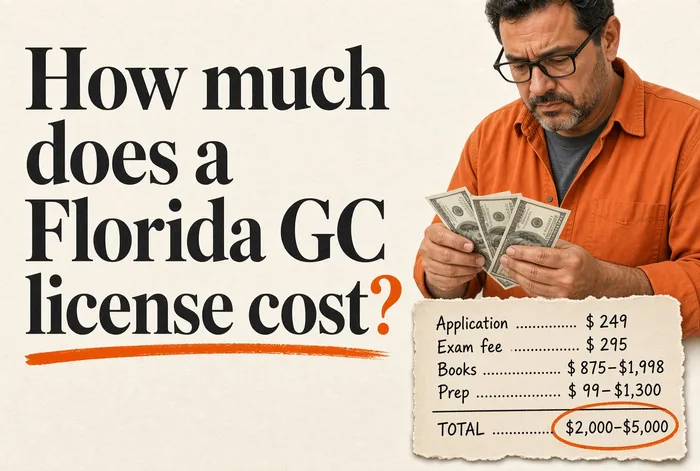
Getting a Certified General Contractor license in Florida starts with $540 in fixed state fees: PTI exam registration ($135), Pearson VUE testing fees ($160 for all three parts) and DBPR’s license application ($245). On top of that come reference books ($499 for our Business and Finance set), fingerprinting, a credit report, insurance and whatever prep you choose. All in, that’s typically around $2,000 to $5,000. The fees aren’t the only bar, either — most people need four years of qualifying experience before they can sit. Here are the full general contractor license requirements in Florida.
Our Business and Finance course is $197 for Business and Finance, the longest part of the exam.
What you earn
Licensed general contractors in Florida earn across a wide range depending on how they use the license.
Working as an employee — superintendent, estimator, or project engineer — a fresh license holder typically starts at $55,000 to $75,000, with experienced professionals earning $100,000 to $130,000+.
As a project manager for a builder or developer, licensed GCs earn $90,000 to $150,000+. Commercial, healthcare, and government projects tend to pay at the top end.
Running your own company, income is tied to project volume. A GC running $1 million in annual projects at a 10% net margin takes home $100,000 before taxes. At $3 million, that’s $300,000. The ceiling is whatever you can build.
The ROI math
At the lowest earning level — $55,000 — the entire cost of getting licensed pays for itself in about two to three weeks of work.
Compare that to other credentials:
An MBA costs $60,000 to $120,000 and takes two to three years. Even a $15,000 salary bump takes years to break even.
A bachelor’s degree costs $30,000+ in student debt and four years. The average graduate enters a white-collar job market where 6 in 10 professionals now say they’d consider switching to trades.
The GC license doesn’t require you to stop working. You study while employed, take the exam, and your earning potential increases immediately once you pass.
The market context makes it even more compelling
Florida added 37,100 construction jobs from September 2023 to September 2024 — a 5.9% growth rate, second only to Texas. Construction wages in the state rose 6.5% year-over-year.
The demand side is even more striking. Florida needs an estimated 439,000 additional construction workers. Over 40% of the current workforce is nearing retirement. For every five experienced workers leaving the field, only one new worker is entering.
That supply-demand gap is structural, not cyclical. Florida is adding 1,000+ new residents per day. Housing, infrastructure, and commercial construction projects aren’t slowing down.
For a licensed GC, this means more job opportunities, more negotiating leverage, and upward pressure on compensation.
Who it makes the most sense for
The GC license makes the most financial sense in a few specific situations.
You’re already working in construction without a license. This is the clearest case. You know the industry, you have the required four years of experience, and the license removes the ceiling on what you can do and earn. Without it, you’re limited to working under someone else’s license.
You’re considering a career switch into construction. If you’re in your mid-to-late 20s, have some construction experience, and you’re comparing the ROI of a graduate degree to a trade license — the numbers favor the license by a wide margin. 42% of Gen Z college grads are now working in or pursuing blue-collar careers. This isn’t a fringe trend. It’s a structural shift driven by student debt, AI displacement fears, and the economics of trades vs. white-collar work — we run that comparison in full in trades vs. college degree: the math in 2026.
You want to start your own contracting business. The GC license is the legal prerequisite to operating as a general contractor in Florida. Without it, you can’t pull permits on projects over a certain scope. With it, you can bid on commercial and residential projects statewide.
Who should think twice
The license requires four years of construction experience. If you have zero time in the industry, you’re not eligible yet — though a four-year degree in civil engineering, building construction or architecture cuts it to one year, and college credits can stand in for up to three years if you also have a year as a foreman.
The exam also isn’t trivial. It’s a three-part, open-book, computer-based test. Business and Finance is 120 questions in 6.5 hours. It’s also the most math-heavy. Contract Administration and Project Management are shorter but still require a 70% passing score each.
This isn’t a checkbox credential. You need to study, prepare your reference books, and take the exam seriously — our guide on how to pass the Florida GC exam covers how. But if you do, the return on that effort is hard to beat.
The bottom line
A Florida GC license costs $540 in state fees plus books, prep and insurance, takes a few months of study, and opens the door to $80,000 to $150,000+ in earning potential — with an uncapped ceiling if you run your own business.
In a state that needs hundreds of thousands of construction workers and is growing faster than almost any other market in the country, the question isn’t really whether the license is “worth it.” It’s how long you want to wait before getting it.
If you’re ready to start prepping, the free timed practice exam shows you where you stand today, and the Business and Finance course is $197 when it opens. If you’re still in the research phase, grab the free cost breakdown first.
Related posts